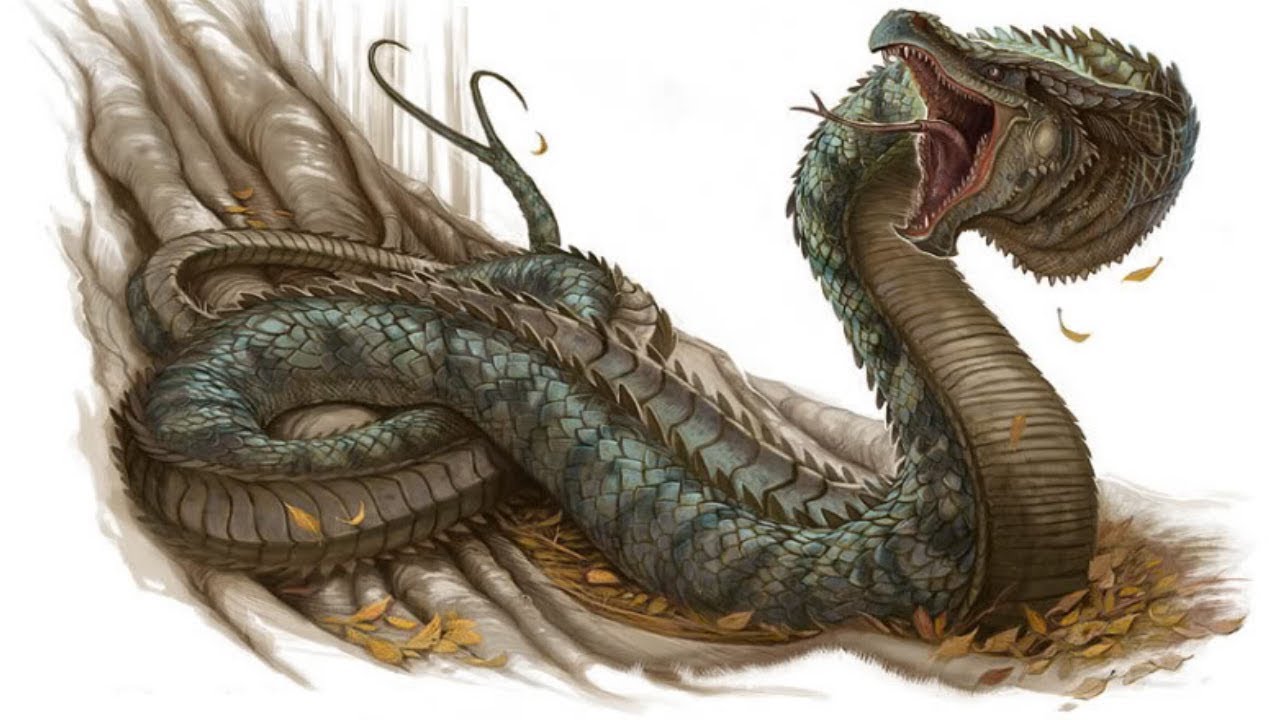
wherearewegoing.net – The basilisk, often hailed as the “King of Serpents,” is a legendary creature that has captivated the human imagination for centuries. Originating from ancient myths and folklore, the basilisk is depicted as a serpent with the power to kill with a single glance. This mythical beast has been a subject of fascination in various cultures, each adding its unique twist to the creature’s lore.
Origins and Evolution of the Basilisk Myth
The basilisk’s origins can be traced back to ancient Greece, where it was believed to be a small, venomous snake. However, the creature’s legend grew more elaborate over time, with the Romans and later the medieval Europeans contributing to its mythos. By the Middle Ages, the basilisk had evolved into a monstrous serpent with a crown, symbolizing its royal status among serpents.
Ancient Greece and Rome
In Greek mythology, the basilisk was said to be hatched from a cockerel’s egg, incubated by a toad or serpent. It was believed to have the power to kill not just humans but also other animals and even plants with its gaze or breath. The Romans further embellished the creature’s abilities, claiming it could kill with a single glance and that its venom was so potent it could dissolve diamonds.
Medieval Europe
During the Middle Ages, the basilisk’s legend reached its zenith. It was believed to be a creature of immense power, capable of destroying entire armies with its gaze. Knights and sorcerers were said to embark on quests to slay the basilisk, using mirrors to deflect its deadly stare.
The Basilisk in Magic and Alchemy
The basilisk’s association with magic and alchemy is deeply rooted in its mythology. Alchemists sought to harness the basilisk’s powers, believing its venom could be used to create powerful potions and elixirs. In some traditions, the basilisk was seen as a symbol of transformation and rebirth, embodying the alchemical process of turning base metals into gold.
Protection Against the Basilisk
Given the basilisk’s fearsome reputation, various methods were devised to protect oneself from its deadly gaze. Carrying a weasel, which was believed to be immune to the basilisk’s venom, was one such method. Another was to use a mirror, reflecting the basilisk’s gaze back at itself, causing it to die instantly.
The Basilisk in Popular Culture
The basilisk has made numerous appearances in literature, film, and other media, often portrayed as a formidable antagonist. From J.K. Rowling’s “Harry Potter” series to the “Pokémon” franchise, the basilisk continues to fascinate and inspire creators and audiences alike.
In Literature and Film
In literature, the basilisk has been a recurring motif, symbolizing danger, power, and the unknown. Films and television shows have also capitalized on the creature’s menacing reputation, depicting it as a creature of immense power and malevolence.
Modern Interpretations
Modern interpretations of the basilisk often blend traditional mythology with contemporary themes, exploring the creature’s symbolism and its relevance in today’s world. Whether as a metaphor for unchecked power or as a symbol of transformation, the basilisk remains a versatile and intriguing figure in popular culture.
Conclusion
The basilisk, with its potent mix of danger and mystery, continues to captivate the human imagination. As a symbol of power and transformation, it embodies the enduring fascination with the unknown and the supernatural. Whether in ancient myths or modern media, the basilisk remains a potent symbol of the serpentine mysteries that have intrigued humanity for generations.